
Differing Judicial Opinions on Trial of Civilians in Military Courts: “Army’s Job is National Defense, Not Running Courts
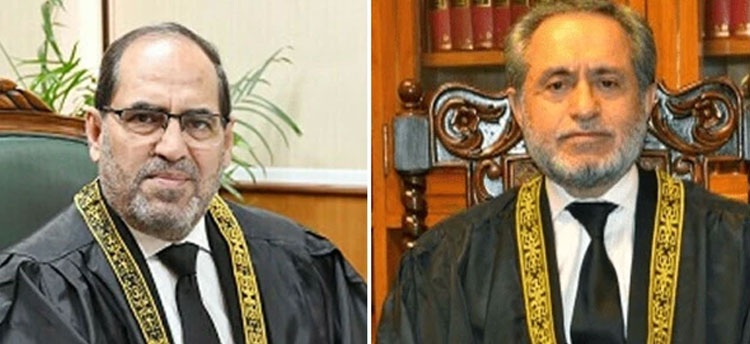
Islamabad (Web Desk) – A dissenting note has been issued by two judges regarding the intra-court appeals on the trial of ordinary civilians in military courts. The note states that it is not the role of military officers to punish criminals; the army’s primary duty is to defend the country, not to run judicial proceedings. If the military starts performing judicial functions, public trust in them will erode.
Justices Jamal Mandokhail and Naeem Akhtar Afghan disagreed with the majority verdict and have made their dissenting opinion public.
The majority decision by five judges had upheld the legality of trying ordinary civilians in military courts. The detailed dissenting note, authored by Justice Jamal Mandokhail, spans 36 pages.
In the note, the judges clarify that military courts are typically established worldwide to deal with terrorism-related cases, but it is incorrect to assume they have no ability or willingness to deliver justice. Although sentences in military courts are generally lighter, that does not mean justice cannot be served there.
The note points out that the Supreme Court continuously reviews decisions of lower courts and has observed many acquittals in baseless political cases, often resulting from unprofessional investigations and weak prosecutions.
The dissenting judges further state that intra-court appeals were filed by the federal government and the governments of Punjab and Balochistan, which seems to reflect a lack of confidence in the criminal courts by these governments. It is regrettable that these elected governments have lost faith in criminal courts and have burdened military courts with politically motivated cases — a situation beyond comprehension.
The note also highlights that military officers presiding over military courts are experts in military affairs but lack judicial experience and proper training to handle such cases. Military courts should not be considered equivalent to regular courts, whose officers possess judicial expertise and independence.
The judges criticized the federal and provincial governments for relying on military courts to deal with terrorism cases instead of properly addressing them through civilian courts. Expecting military courts to convict people without evidence constitutes a violation of the right to a fair trial. How can military courts convict without sufficient evidence?
The note adds that some individuals subjected to court-martial in connection with the May 9 cases have approached the court. After the Supreme Court’s order dated March 25, 2024, civilian trials continued in military courts and sentences were handed down. Many civilians have been convicted by military courts, which lack jurisdiction to try ordinary citizens. The convictions and trials of civilians in the May 9 cases should be declared null and void.
The dissenting note further states that a misconception has been created that if criminal courts fail to eliminate terrorism, then military courts are the solution. Has terrorism ended due to sentencing terrorists in military courts under the 21st Constitutional Amendment? The answer is no. Fundamentally, it is not the role of military officers to punish criminals; their job is to defend the country, not to adjudicate legal matters. If the army begins to perform judicial functions, public trust in the military will decline. It has also been correctly pointed out that fundamental rights protections are not guaranteed in military courts.
0 Comments