
Talpur Calls Skills, Interest-Free Financing, and MSME Growth Cornerstones of Economic Empowerment
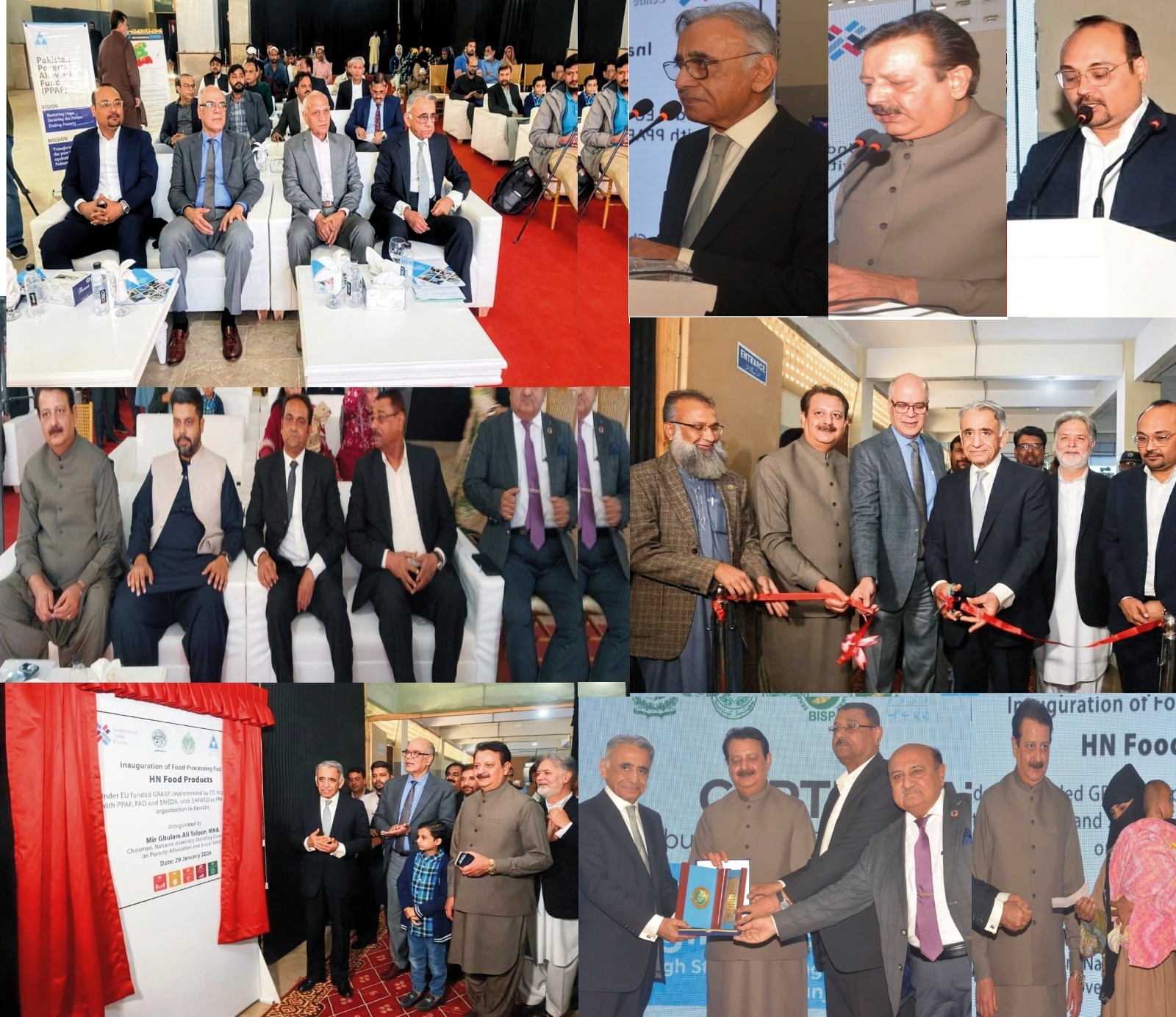
Hyderabad: Chairman of the National Assembly Standing Committee on Poverty Alleviation and Social Safety, Mir Ghulam Ali Talpur emphasized that skills development, interest-free financing, transfer of assets and MSME growth are critical to empowering communities and achieving sustainable poverty reduction across Pakistan. He was speaking as the Chief Guest at the Prime Minister’s Interest-Free Loan Programme Cheque Distribution Ceremony and the inauguration of HN Food Products factory, organized by the Pakistan Poverty Alleviation Fund (PPAF) in Karachi under the theme “Economic Graduation through Resilient Livelihoods and MSME Development.”
According to a statement issued by the SAFWCO Head Office Hyderabad, the event held in Karachi was attended by Secretary PA&SS Navid Ahmed Shaikh, representatives from SAFWCO, SMEDA, civil society organizations amd media representatives.
In his address, Mr. Talpur commended PPAF for adopting an integrated development approach that links social protection, livelihood support, enterprise development, and human capital investment. He noted that such initiatives enable vulnerable households particularly women and youth to transition from dependency to dignity through sustainable income opportunities. He also apricated the role of EU, development organizations, ITC and Government stakeholders.
He emphasized education and skilled based trainings and urged PPAF to introduce more skill-based programmes for the youth.
Speaking on the occasion, Mr. Nadir Gul Barech, Chief Executive Officer, Pakistan Poverty Alleviation Fund, highlighted that PPAF has been at the forefront of promoting economic graduation through evidence-based interventions implemented in partnership with 164 local organizations across 150 districts of the country.
He stated that access to skills, finance, and markets remains central to breaking intergenerational poverty.
Referring to financial inclusion efforts, Mr. Barech shared that under the Prime Minister’s Interest-Free Loan Programme, PPAF has facilitated over 1.35 million interest-free loans of PKR 49.3 billion across Pakistan in 67 districts.
In province Sindh more than 270000 loans has been disbursed amounting pkr 9.86 billion.
“The cheque distribution today represents a decisive step towards self-reliance, enabling beneficiaries to invest in livelihoods, micro-enterprises, and small businesses.
Highlighting enterprise development under the GRASP project, an EU-funded initiative implemented by the International Trade Centre (ITC) in partnership with FAO, SMEDA, and PPAF and partner organizations, Mr. Barech noted that 45,726 MSMEs have been mobilized across Sindh and Balochistan. He added that PKR 1.12 billion in loans and PKR 1.32 billion in matching grants have been provided to SMEs, resulting in increased investments, higher sales turnover, over 40,000 job creation, and the adoption of 80% climate-smart and cleaner production practices.
While addressing the audience, Inam ul Haq, representative of Home Department Sindh on Centre for Excellence on Countering Violent Extremism (CVE) said that, government is fully committed to promote such kind of initiatives to improve socio economic conditions of the communities to prevent Extremism ideologies.
He further highlighted that the Government of Sindh is providing all available opportunities to empower youth and women to promote social cohesion and an inclusive society. He applauded the efforts of PPAF to improve the lives of poorest people at grassroot levels across the country.
The event also marked the inauguration of HN Food Products, a GRASP-supported food processing facility in Karachi’s North Industrial Area, demonstrating how targeted financial and technical support helps MSMEs upgrade technology, expand operations, and access new markets.
A key highlight of the ceremony was the distribution of certificates among graduates of vocational and skills development programmes under the “Economic Empowerment of Marginalized Communities Project.”

Advertisement

Comments (0)